Power Meets Performance

Hana
| 17-08-2026
 · Automobile team
Hello, Lykkers! If you are thinking about buying a golf cart, one of the first decisions you will face is surprisingly important: should you choose electric or gas?
Both can be excellent choices, but the better option depends on where you drive, how far you travel, and how much maintenance you are comfortable handling.
Electric Golf Carts: Quiet and Convenient
Electric golf carts are powered by rechargeable batteries, with modern models increasingly using lithium-ion technology. Their biggest advantage is quiet operation. They are particularly appealing for golf courses, residential communities, resorts, and short trips where engine noise can become annoying.
Electric carts also require less routine mechanical maintenance. There is no engine oil, spark plug, or fuel filter to service. However, batteries remain an important consideration. Lead-acid batteries require more care, while lithium batteries generally require less routine attention but can cost more initially.
According to State Farm, electric golf carts can typically travel around 15–25 miles with a fully charged 36-volt system and roughly 25–40 miles with a standard 48-volt system, although actual range varies by battery, terrain, load, and driving conditions.
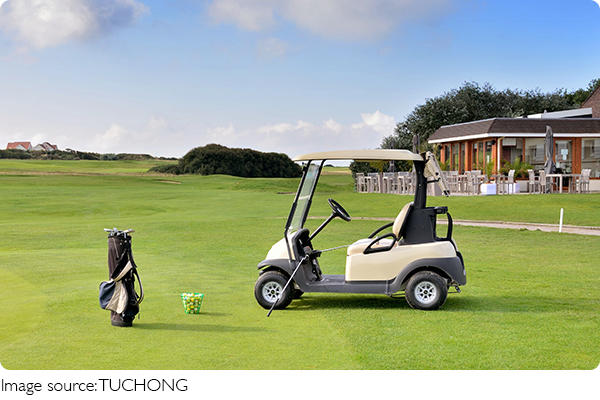
Gas Golf Carts: Built for Longer Runs
Gas-powered golf carts use small combustion engines and are especially useful when range and quick refueling matter. Instead of waiting several hours for a recharge, you can refill the tank in minutes and continue driving.
That makes gas carts attractive for large properties, steep terrain, utility work, and situations where the cart may be used continuously throughout the day. The trade-off is greater maintenance. Gas models need engine-related servicing such as oil and filter changes, spark-plug checks, and other mechanical upkeep.
They are also louder and produce exhaust emissions, which can make them less appealing for quiet residential environments.
What Does an Engineer Recommend?
Engineering analysis from sources such as Engineer Fix emphasizes that neither technology is universally superior. Electric carts suit owners prioritizing quiet operation, lower routine maintenance, and short-distance use, while gas models make more sense when extended range, sustained power, and rapid refueling are priorities.
That is an important point. Choosing a golf cart is less about picking the “best” technology and more about matching the technology to your lifestyle.
Electric vs. Gas: The Everyday Difference
Think about your typical day. If you mainly travel a few miles around a neighborhood, golf course, or private community, an electric cart can be wonderfully convenient. Plug it in when you return, and it is ready for the next trip.
If you regularly travel long distances or tackle hills while carrying passengers, tools, or equipment, gas may give you greater flexibility. Gas also has an advantage if charging infrastructure is limited.
Cost matters, too. Electric carts generally have lower day-to-day energy and routine maintenance costs, while gas carts involve ongoing fuel and engine-service expenses.
So, Which Should You Choose?
Choose electric if you want:
- Quiet, smooth operation
- Lower routine maintenance
- Convenient overnight charging
- A cart for neighborhoods, golf courses, and short trips
Choose gas if you need:
- Longer range between stops
- Fast refueling
- Strong performance for demanding terrain
- A cart for large properties or heavier utility use
The Bottom Line
There is no one-size-fits-all winner. For everyday recreational and neighborhood use, electric is often the more convenient choice. For demanding work, long-distance travel, or remote locations, gas can still be the practical champion.
Before buying, consider your typical distance, terrain, charging access, maintenance budget, and intended use. Once you answer those questions, the right golf cart becomes much easier to spot.