Why Proportions Matter

Kwame Johnson
| 20-08-2026
 · Automobile team
Hi, Readers! Few car shapes feel as instantly right as a sports car with a long hood, a cabin set slightly rearward, and a short rear deck.
Even before you know anything about output, chassis tuning, or weight distribution, that silhouette signals speed, purpose, and balance. It is not just a styling habit.
The proportions connect visual expectations with packaging, dynamics, and the way people read motion from a stationary object.
A sports car is often judged in one glance, and proportion does most of the work in that first impression. A long front section visually stretches the car and gives it a stronger sense of forward movement. The short rear section keeps the body compact and focused, so the whole form looks ready to move instead of simply taking up space. When designers place the passenger compartment farther back, the front wheels appear more prominent within the body, and that usually makes the car look more athletic and controlled.
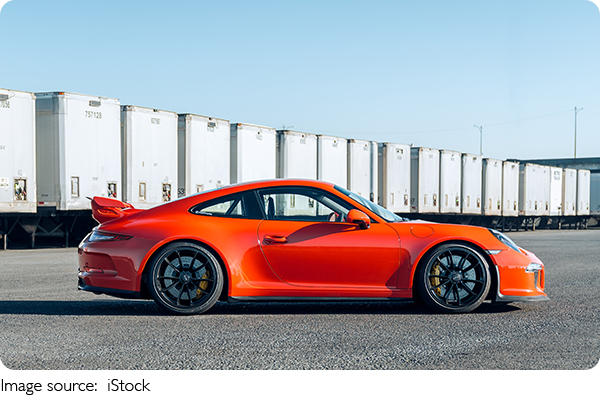
Why the long hood works
The long hood became a classic cue partly because of engineering realities. Traditional front-engine sports cars needed room for the powertrain, cooling hardware, suspension geometry, and the structural space around them. When that packaging requirement was handled well, it created a naturally elegant profile. Over time, people began to associate this shape with high performance, even when later engineering no longer required such an extended front section to the same degree.
There is also a strong visual reason. A long hood creates directional emphasis. Your eye moves from the nose toward the cabin in a smooth line, and that line suggests momentum. The body seems to point forward with confidence. Compared with a short, upright front end, the longer form feels lower, sleeker, and more deliberate. That perception matters because sports cars are sold not only through measurable capability but also through emotional clarity.
Why the short rear stays important
The short rear deck plays an equally important role. If the rear section grows too long, the car can start to look heavy or less agile. A compact tail reduces that effect and helps the mass of the vehicle appear concentrated between the wheels. That is a powerful visual message because cars that look like their mass is centralized often seem more nimble and responsive.
From a dynamics perspective, keeping major mass near the middle of the car supports responsiveness. Vehicle behavior in cornering, braking, and changes of direction is closely related to how mass is distributed. Even though exterior styling does not automatically guarantee ideal engineering underneath, the classic sports car profile often aligns with the broader principle that balanced mass placement supports sharper responses. So the short rear is not only attractive. It also visually echoes a genuine performance logic.

Cabin position and wheel relationship
Another reason this formula endures is the relationship between the cabin and the wheels. In many appealing sports car designs, the distance from the base of the windshield to the front axle is relatively generous, while the body behind the rear axle is limited. This makes the wheelbase feel visually dominant. When the wheels look like they define the car rather than merely sit under it, the whole vehicle appears planted.
That planted look matters because stance is central to perceived performance. A car with strong dash-to-axle proportion, a low roofline, and tightly managed overhangs often communicates precision before it turns a wheel. Designers use these relationships carefully. Even small shifts in cabin placement or overhang length can change whether a car feels energetic, elegant, or awkward.
Why the formula remains classic
Classic forms survive because they keep solving multiple problems at once. The long-hood, short-rear sports car shape suggests performance, often grows from sound packaging logic, and presents the wheels, cabin, and body in a clear hierarchy. It is easy to read, and that clarity gives it lasting appeal. New technologies may change where components sit and how platforms are arranged, but people still respond to proportion in a deeply consistent way.
That is why the formula continues to appear across generations. It carries history, but it also works in pure design terms. The shape feels stable yet dynamic, elegant yet tense, and compact yet substantial. Those are difficult qualities to combine, which is exactly why this proportion has remained so influential.
In the end, the classic sports car silhouette is not a random convention. It is a visual structure shaped by engineering needs, dynamic principles, and human perception. If you look at a car and instantly feel that it seems fast, balanced, and special, proportion is probably doing the quietest and most important part of the job. Next time you spot one on the street, take a second look at the hood, the cabin, and the tail. That simple relationship explains a lot.