Car Weight & Braking

Priya
| 20-08-2026
 · Automobile team
When a car needs to stop quickly, its weight is only one part of the equation.
A heavier vehicle carries more kinetic energy at the same speed, but that does not automatically mean it will require a longer braking distance.
Stopping performance depends on the relationship between speed, tire-road friction, braking-system capability, vehicle design, load distribution, and road conditions. Understanding these factors explains why cars with different weights can achieve similar or very different stopping results.
What Is Braking Distance?
Braking distance is the distance a car travels from the moment the brakes are applied until it comes to a complete stop. It forms only part of total stopping distance, which also includes the distance traveled while the driver recognizes a hazard and reacts.
Speed has a particularly strong effect on braking distance. Under comparable conditions, braking distance increases approximately with the square of speed. This means a relatively small increase in speed can produce a substantial increase in the distance needed to stop.
Does Weight Determine Stopping Distance?
Not by itself. In an ideal friction-limited braking model, vehicle mass can cancel out of the basic calculation because the maximum available tire force also increases with the load on the tires.
As a result, two cars with similar tire-road friction characteristics can theoretically achieve similar braking distances from the same speed even when their masses differ.
Real-world braking is more complicated. Tire characteristics, brake performance, weight distribution, suspension geometry, vehicle loading, and road conditions can all influence how effectively a car converts available grip into deceleration.
Why Vehicle Mass Still Matters
Although mass does not automatically determine single-stop braking distance, it affects the amount of energy the vehicle must dissipate.
Kinetic energy increases with mass. Therefore, at the same speed, a heavier car carries more energy into a braking event. The braking system must convert that energy into heat and dissipate it.
This becomes especially important during repeated or prolonged braking, when maintaining consistent brake performance depends on effective thermal management. Brake-system capacity, component design, and operating conditions can therefore become significant factors.

The Role of Tires
Tires are the primary link between the vehicle and the road. Their available grip establishes an important limit on how strongly a car can decelerate.
Tire design, tread condition, inflation pressure, temperature, and road surface can all affect traction. When available friction decreases, stopping distances generally increase.
For this reason, properly maintained tires are essential to achieving the braking performance intended by the vehicle's design.
Weight Transfer and Vehicle Design
Braking changes the distribution of load across the vehicle. As the car decelerates, load shifts toward the front axle.
The extent of this transfer depends on factors such as weight distribution, center-of-gravity height, wheelbase, suspension characteristics, and braking-system design.
These characteristics influence how braking forces are shared between the tires and how effectively the available grip can be used.
Why Different Cars Stop Differently
Two cars traveling at the same speed can have different stopping distances even when both are operating under similar conditions.
Differences in tire performance, braking hardware, vehicle geometry, suspension setup, weight distribution, aerodynamic characteristics, and electronic brake control can all contribute to the result.
Consequently, neither vehicle weight nor body style alone provides a reliable prediction of stopping performance. A lighter car is not automatically capable of stopping more quickly than a heavier one.
Road and Weather Conditions
The road surface can significantly change the amount of grip available to the tires. Dry pavement generally provides different traction characteristics from wet or otherwise lower-friction surfaces.
Road gradient also affects stopping performance. An uphill slope can assist deceleration, while a downhill slope works against it.
These conditions are particularly important because the same car, traveling at the same speed, can require different stopping distances as the environment changes.
What Drivers Should Remember
The most important factor drivers can control is speed. Because braking distance rises rapidly as speed increases, choosing an appropriate speed provides a meaningful safety margin.
Tire condition and inflation should also be maintained according to the vehicle manufacturer's specifications. The braking system should receive appropriate inspection and maintenance, while passengers and cargo should remain within the vehicle's specified load limits.
A suitable following distance provides additional time for both driver reaction and braking, especially when traffic or road conditions are changing.
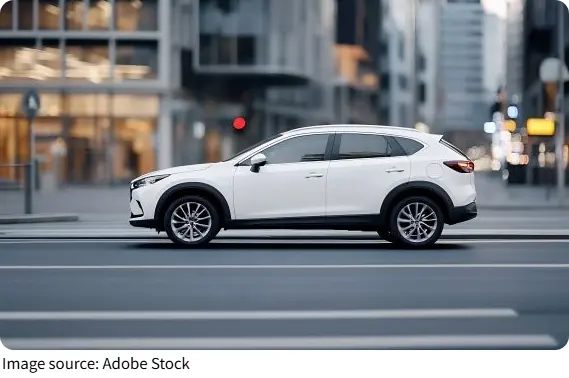
Vehicle weight affects braking, but it does not determine stopping distance on its own. Speed, tire grip, brake performance, vehicle design, load distribution, and road conditions all contribute to how effectively a car can stop.
The key point is that braking performance depends on the entire vehicle system, not weight alone. Maintaining the tires and braking system, adapting speed to road conditions, and leaving sufficient following distance can help provide a greater margin for safe stopping.