Self-Driving Meets Humans

Antonio
| 03-07-2026
 · Automobile team
Hi, Friends! Picture the road as a giant dance floor.
Some dancers are doing their own freestyle thing, and others are following a perfectly choreographed routine programmed by engineers. Now imagine both groups trying to share that floor without stepping on each other's toes.
That, in a nutshell, is what happens when autonomous vehicles and human-driven cars try to coexist on the same roads. Spoiler: it is complicated, but absolutely fascinating.
Why This Is Harder Than It Looks
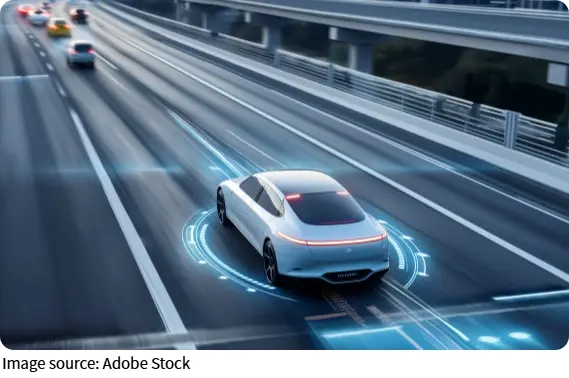
The dream of fully autonomous vehicles zipping around on their own sounds like pure sci-fi magic. But here is the thing -- we are not jumping straight from "everyone drives manually" to "nobody touches a steering wheel." We are in this long, messy middle period where self-driving systems and human drivers are literally sharing lanes, intersections, and parking lots every single day.
It is like being halfway through switching from driving on the left side of the road to the right. Nobody wants to be in that transition moment.
Autonomous driving systems are built on data, sensors, cameras, radar, and lidar that can process their surroundings faster than any human brain. But human drivers are unpredictable creatures.
We cut lanes, hesitate at green lights, make eye contact with pedestrians to signal "go ahead," and do a thousand little social cues that no algorithm has fully cracked yet. The gap between machine logic and human instinct is where most of the headaches live.
The Handover Problem Nobody Talks About Enough
One of the trickiest parts of this collaboration is the handover moment -- when an autonomous system says "okay, human, you take it from here." Research has consistently shown that drivers who have been in a passive, hands-off mode for even a few minutes take dangerously long to regain full situational awareness.
You cannot just tap someone who has been half-napping in the passenger seat and say "drive now, there is a tricky merge ahead." The human brain needs a warm-up lap.
This is why the design of human-machine interfaces inside these vehicles matters enormously. It is not just about flashy screens and voice commands. It is about how the vehicle communicates its intentions, builds trust with the driver, and prepares humans to step back into control without panicking. Think of it like a co-pilot system on an airplane -- both sides need to know exactly who is responsible for what, at every second.
Mixed Traffic: Teaching Robots to Read Human Behavior
On roads with mixed traffic, autonomous vehicles have to essentially learn to "speak human." They need to anticipate that the driver ahead might brake suddenly for no obvious reason, or that someone might wave another car through at an intersection even when they technically have the right of way. These social driving norms differ by region, road type, and even time of day.
Researchers and engineers are working on what they call "cooperative driving" frameworks, basically a set of shared rules and communication protocols between automated and non-automated vehicles. Some of this happens through vehicle-to-vehicle (V2V) communication technology, where cars literally talk to each other via radio signals.
Others are working on smarter road infrastructure that broadcasts real-time information to all vehicles, automated or not.
Trust Is the Real Road Block
Beyond the technical challenges, there is a deeply human issue sitting right in the middle of all this: trust. Studies show that people are pretty nervous about sharing the road with fully autonomous vehicles. And honestly, that is fair. A self-driving car that hesitates awkwardly at a four-way stop or misjudges a cyclist's intention can erode public confidence faster than any bad press release.
Building that trust requires transparency. Autonomous vehicles need to signal their intentions clearly -- through visual displays, brake lights, or even external screens that show pedestrians and nearby drivers what the car "sees" and what it plans to do next. The more legible these machines become to human road users, the smoother the coexistence gets.
At the end of the day, the path to truly autonomous roads runs straight through human collaboration, not around it. Getting self-driving systems and human drivers to play nicely together is not just an engineering challenge -- it is a social one.
The smartest approach is designing systems that respect human unpredictability, communicate clearly, and build trust one ride at a time. So next time you see a self-driving vehicle on the road, maybe give it a little wave. It is just trying to figure us out, too.